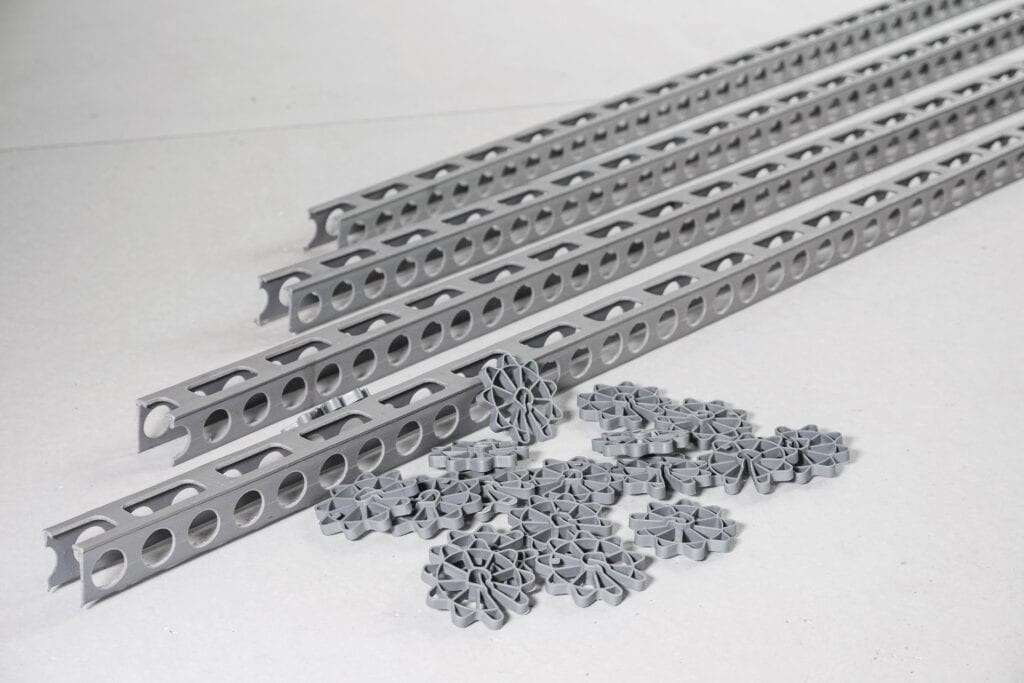
Plastic spacers play an important role in the structural support and durability of modern buildings. They are discreet components, often small and simple-looking, yet they perform a crucial function in ensuring the quality and integrity of structures.
Plastic spacers are used in various contexts in civil construction, but are most commonly employed in assembling reinforcement in reinforced concrete structures. Their main function is to maintain proper spacing between the steel bars that make up the reinforcement, ensuring they are correctly positioned relative to the surrounding concrete.
Besides their support and spacing function, these devices have a direct impact on the sustainability of buildings — here are some important points:
- Reduced steel consumption: by using spacers, it is possible to ensure the correct amount of steel is used in each structure, avoiding waste. Efficient use of resources is an essential practice for making the construction industry more sustainable.
- Structural durability: correctly positioning the reinforcement with the help of spacers contributes to the durability of buildings. Reinforced concrete is vulnerable to corrosion of the steel bars, which can occur if there is direct contact between the bars and the concrete. Spacers help prevent this problem, extending the structure’s service life.
- Energy efficiency: well-designed structures built with proper spacers can result in more energy-efficient buildings, since a well-assembled structure reduces the chances of future problems such as leaks or cracks.
- Waste reduction: plastic spacers can be reused in some situations, reducing the amount of construction waste generated. In addition, the plastic materials used to manufacture these devices can be recycled.
- Light weight: the use of plastic spacers also facilitates construction logistics, since these components are lightweight and easy to handle, reducing fuel consumption during transport.
In summary, plastic spacers play an essential role in supporting buildings, contributing to durability, energy efficiency and waste reduction. When used consciously and responsibly, these devices help promote the construction of more sustainable, environmentally friendly buildings.